TL;DR
- The model is a commodity. Claude, GPT, Gemini and Llama all clear the quality bar — the next 10% of accuracy isn't where enterprise value is created.
- The harness is the product. What an AI sees, remembers, and is permitted to do on your data — that's the real moat.
- Four levels of governed capability: data augmentation, institutional memory, workflow orchestration, and productivity integration.
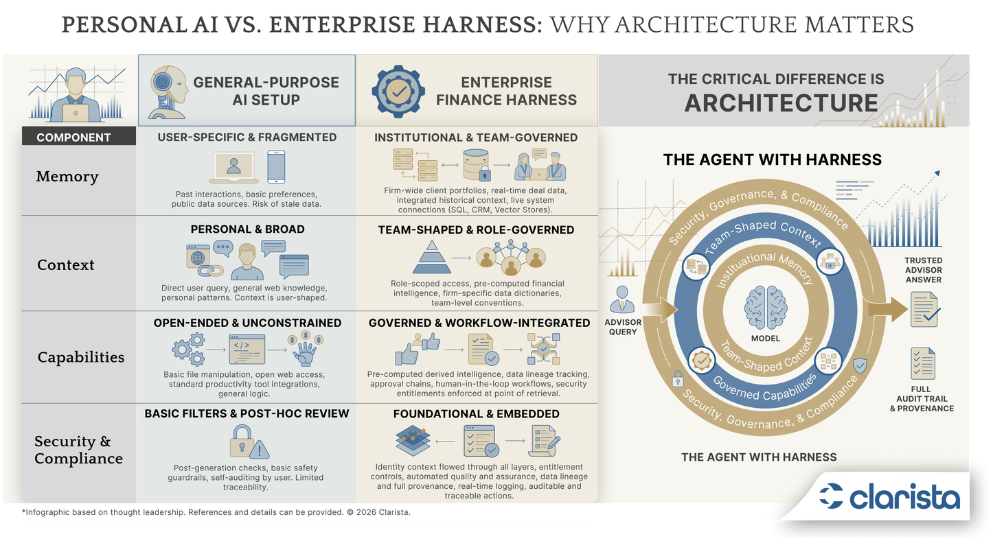
- Personal AI ≠ Enterprise AI. ChatGPT remembers you. Enterprise AI must remember the firm — role-shaped, team-shaped, audit-shaped.
- Own your harness or rent your future. Firms that hand the harness to a vendor surrender the most sensitive part of their AI stack.
The model is a commodity. Claude, GPT, Gemini and Llama all clear the quality bar — the next 10% of accuracy isn't where enterprise value is created.
The gap between personal AI and enterprise AI is not a technology problem: it is an architecture problem. While large language models provide raw intelligence, they lack the institutional context and governance required for regulated finance. To bridge this gap, firms must look beyond the model to the Harness: the architectural layer that dictates what an AI sees, remembers, and is permitted to do.
In this white paper, Suvrat Bansal, Founder and CEO of Clarista, explores why the harness is the true differentiator in the next era of financial services. You will learn how to transition from generic chatbots to governed AI agents that possess true institutional memory.
The Harness white paper discuss at length:
- The Enterprise AI Gap: Why models fail when working with live, sensitive enterprise data and how architecture solves the training and governance deficit.
- Institutional Memory vs. Personal Recall: Why financial AI must be team-shaped and role-governed, ensuring data sovereignty and continuity.
- The Four Levels of Governed Capabilities: How to move from simple data augmentation to full workflow orchestration and productivity integration.
- Ownership of the Advantage: The strategic importance of controlling your own harness to protect the firm’s most sensitive assets.
Download the white paper by filling out the form below.
Get the full whitepaper
Download the complete PDF — read it offline, share it with your team, attach it in a deal.
↓ Download PDFWant to apply this in your firm?
Clarista is the production-grade enterprise AI platform behind this research. 20-minute demo: bring your scenario, we'll show you what's possible on your data.
Book a demoFrequently asked questions
What is an AI harness?
The harness is the architectural layer that controls what an AI model sees, remembers, and is permitted to do inside an enterprise. It includes the data access layer, the memory layer, the governance layer, and the orchestration layer — everything around the LLM that turns a raw model into a usable, accountable enterprise tool.
Why isn't the model the product?
Foundation models like Claude and GPT are increasingly commoditised — they all clear the accuracy bar for most enterprise tasks. The differentiator is no longer the model, it's the architecture around it: which data the model can see, which actions it can take, how it remembers context across users and teams, and how every decision is logged for audit.
How is enterprise AI different from personal AI?
Personal AI tools like ChatGPT remember you — your preferences, your past conversations. Enterprise AI must remember the firm: it has to be team-shaped, role-governed, and continuous even as people move between roles. It also has to enforce data sovereignty and pass an audit trail to compliance.
What happens if I let a vendor own my harness?
You surrender the most strategic part of your AI stack. The vendor sees how your firm makes decisions, what data your AI accesses, and which workflows depend on it. If they raise prices, get acquired, or change policy, you have nowhere to go. Owning the harness keeps the strategic surface inside your firm.
Who is this whitepaper for?
CIOs, CDOs, CTOs and Heads of AI at financial services firms — particularly wealth management, asset management, and insurance — who are moving from AI pilots to production deployments and need a framework for what to build vs. what to buy.
Does Clarista provide a harness?
Yes. Clarista is purpose-built as a governed harness for enterprise AI. It connects your data sources, enforces row- and column-level access, gives every AI agent role-aware memory, and produces a complete audit trail of every model interaction. See how it works →